 Język Polski
 English

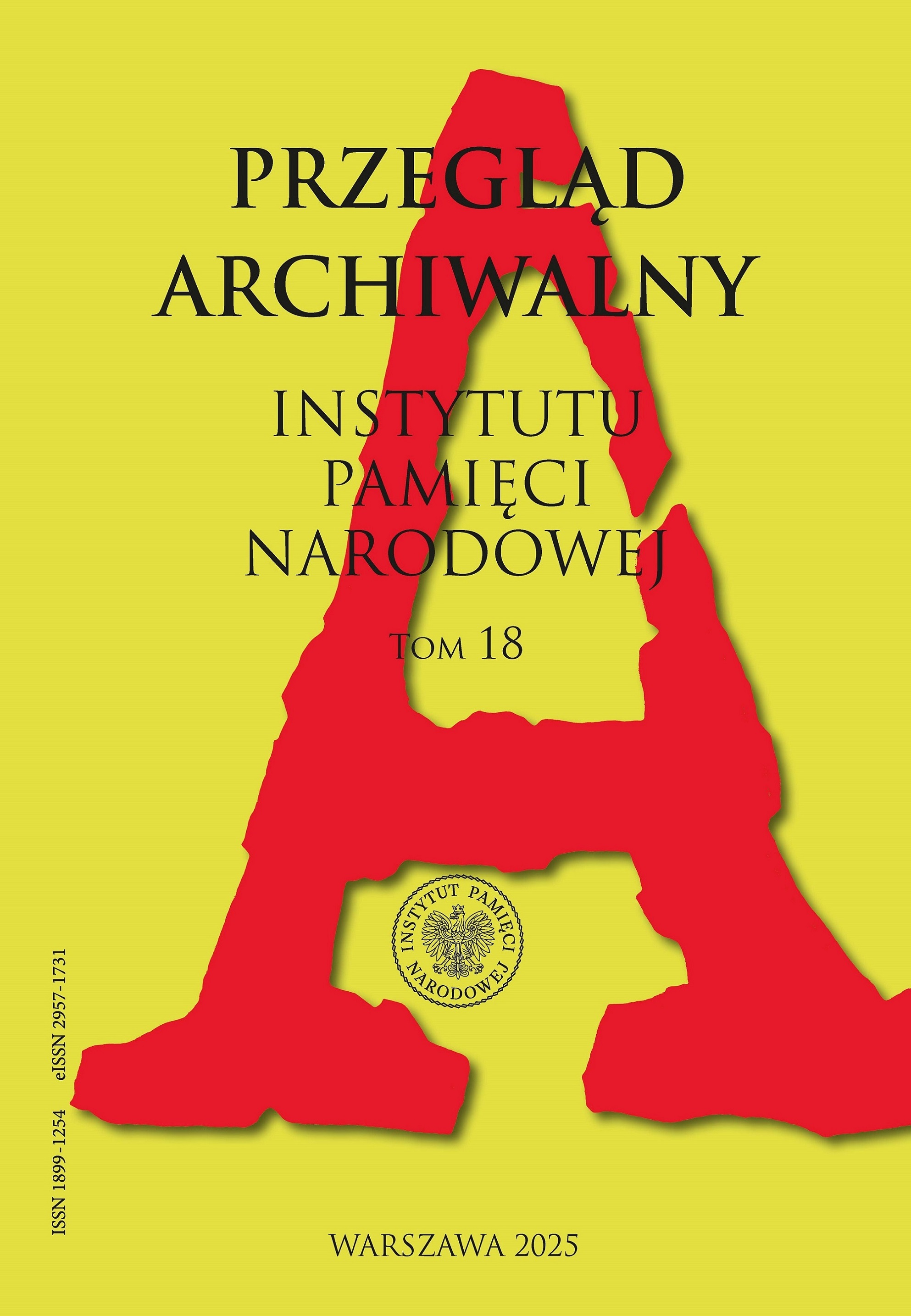
Vol. 18 (2025)
-
Foreword
Przegląd Archiwalny Instytutu Pamięci Narodowej, Vol. 18 (2025), pages: 9-12
 PDF (Język Polski)
Archive 
-
The MBP Central Archive and Its Predecessors (1944–1954) – Organization, Personnel, and Activities
Przegląd Archiwalny Instytutu Pamięci Narodowej, Vol. 18 (2025), pages: 13-56
The article is devoted to a little-known unit of the public security apparatus, which operated between 1944 and 1954 under the names: “MBP (Ministry of Public Security) Archive,” “MBP Main Archive,”and “MBP Central Archive.” The text focuses primarily on presenting its organisation and staff, as well as discussing its main areas of activity in the years 1944–1954. It was not a typical archival unit operating within an institution or office, but rather an auxiliary unit that provided operational departments with the information they needed to carry out their activities. It collected documents from the interwar period and the occupation, which, in addition to their historical value, were an important source of information about potential enemies and political opponents of the new authorities.
-
Card Index Holdings of the Operational Records Office/Bureau “C” from 1957–1990 and Currently
Przegląd Archiwalny Instytutu Pamięci Narodowej, Vol. 18 (2025), pages: 57-104
The Bureau “C” index card files were of great importance for the efficient functioning of the Security Service’s personal and material records system. This article discusses the work of Divisions I and III of Bureau “C,” which were responsible for maintaining alphabetical, issue-based, statistical, and topical files. A comparison of the norms concerning the card indexes and reports of Bureau “C” allowed for a confrontation of theory with the practical functioning of the Security Service’s file holdings. This made it possible to formulate several research hypotheses, which were then tested. The issue of the computerisation of card index collections and the creation of the Integrated Operational Card Index System (Zintegrowany System Kartotek Operacyjnych, ZSKO) was also raised. The picture is supplemented by a presentation (in the form of a table) regarding the state of preservation of the SB’s card indexes held at the Institute of National Remembrance. The primary sources for this study are the regulations and documentation of Bureau “C”; these are mainly reports and information on the state of the card index records. The issue requires in-depth research into the functioning of the card indexes in the late 1980s and early 1990s. We still lack information on the circumstances surrounding the creation of the card indexes (including MSW’s general information reconstruction card index) and on their ten-year “stay” at the Office for State Protection.
-
The Division of the IT Operational Records Repository of the PRL Ministry of Internal Affairs Between the Police and the Office for State Protection from 1990–1994 Against the Backdrop of the Separation and Digitisation of the Ministry’s Manual Card Index Files
Przegląd Archiwalny Instytutu Pamięci Narodowej, Vol. 18 (2025), pages: 105-130
This article examines the transfer of the electronic operational repository to the Police by the PRL Ministry of Internal Affairs, and subsequently to the Office for State Protection, in the period from 1990–1994, taking into account the division and digitisation of the Security Service’s manual card indexes. It also takes into account the context of data digitisation at the Ministry of Internal Affairs in 1991. The focus was primarily on events during two periods: 1990 and 1991–1994. In the first instance, manual card indexes were divided between the Information Technology Bureau of the National Police Headquarters (Central Criminal Card Index, BI KGP), the MSW PESEL Department (Central Address Bureau) and the Records and Archives Bureau of the Office for State Protection (UOP) (Central General Information Card Index). In the case of BI KGP and the MSW PESEL Department, this was intended to facilitate their further digitisation based on their existing and expanding IT technical facilities. However, the UOP Records and Archives Bureau did not at that time have the necessary infrastructure to carry out such activities. Furthermore, that year the IT systems and electronic data of the former Security Service (primarily the Integrated Operational Records System, ZSKO) were transferred to the newly established police force. There may have been two reasons for this decision – either it was a political decision taken at the highest levels of government, or it was influenced by the actions of the police labour unions, which were exceptionally powerful at the time. During the second period under discussion, this situation was rectified – firstly, through provisions in internal departmental regulations from 1991–1992, and later through measures taken over the following two years – during which time, the electronic data of the former Security Service (SB) was transferred from the Information Bureau of the National Police Headquarters (BI KGP) to the Information and Records and Archives Bureau of the Office for State Protection (BEiA UOP). This was accompanied by the gradual development of a new police information system – the Integrated Police Information System (Zintegrowany System Informacyjny Policji, ZSIP), which was completed in 1996.
-
The Office for State Protection 1992 Investigation into the Destruction of MSW Department I Operational Records Between 1989 and 1990
Przegląd Archiwalny Instytutu Pamięci Narodowej, Vol. 18 (2025), pages: 131-172
The problem of the destruction of active and archived MSW Department I operational files during the political transformation is discussed in the article. After the Contract Sejm elections and the formation of Prime Minister Tadeusz Mazowiecki’s government, all units of the Security Service, including the civilian intelligence service, began destroying case files and other types of documentation. This process began in September 1989 and reached its peak in the second half of January 1990. Many documents were also destroyed at a later date. After the formation of Prime Minister Jan Olszewski’s government (December 1991), a Research Division was established in the Office of the Minister of Internal Affairs. Its purpose was to examine the Security Service archives with a view to vetting the authorities of the Polish Republic. In the course of these activities, it was discovered that the some of the protocols from the culling of cases in MBP Department I had been falsified. Evidence was also found indicating that former SB functionaries had misappropriated archival materials for themselves. An investigation into this matter was conducted by the Investigative Office of the Department of State Protection. After the dismissal of the government and changes in the leadership of the services, the proceedings were discontinued. The documentation available today is an important supplement to our knowledge of the circumstances surrounding the destruction of documents by the intelligence services of the Polish People’s Republic.
Archival repository
-
Michał Gwalbert Pawlikowski’s Emigration Experience (1939–1940) in the Light of His “Detailed Diary” and Other Personal Documents
Przegląd Archiwalny Instytutu Pamięci Narodowej, Vol. 18 (2025), pages: 173-196
Michał Gwalbert Pawlikowski (1887–1970) was a representative of the Polish landed gentry and the homeland intellectual elite. Until 1939, he managed his family estate in Medyka, while being a writer, poet, collector, and publisher of the Biblioteka Medycka series, as well as an activist of the National Democracy movement. In September 1939, he was separated from his family, who remained in the occupied country. He managed to get to Italy, where he organised aid for Poles in Romania and Hungary for several months. At the same time, he made efforts to gain influence in the political life of the Polish émigré community. The article, based on Pawlikowski’s diary, discusses his fate after the outbreak of World War II and during his first months in Italy. It describes his attempts to become involved in the political and social affairs of the Polish émigré community, as well as answering the question of his role in that community during this period.
-
The 13th Vilnius Rifle Battalion’s Chronicle as a Research Source into the History of the Polish Armed Forces
Przegląd Archiwalny Instytutu Pamięci Narodowej, Vol. 18 (2025), pages: 197-218
The archives of the Polish Institute and Sikorski Museum in London contain the chronicle of the 13th Vilnius Rifle Battalion (13. Wileński Batalion Strzelców). It presents the history of one of the many units of the Polish Armed Forces that fought for Poland’s independence during World War II. This unit was part of the II Polish Corps under the command of Major General Władysław Anders, fighting battles at Monte Cassino, Ancona, and Bologna, among others. The pages of the chronicle describe the history of the battalion from the moment of its establishment, its stationing in the Middle East in 1942–1944, the period of fighting on the Apennine Peninsula (1944–1945), and the last years of its existence in Great Britain. In comparison to other chronicles in the London institution’s collection, the chronicle of the Vilnius battalion is one of the most valuable and well crafted. Its content was compiled very carefully and meticulously, and is enriched with many interesting photographs and illustrations. This chronicle is an important source for research into the history of the Polish Armed Forces in the years 1942–1947.
-
Reflections of a Radical Piłsudski Supporter: The “1941–1961 Diary” of Apoloniusz Zarychta
Przegląd Archiwalny Instytutu Pamięci Narodowej, Vol. 18 (2025), pages: 219-246
Apoloniusz Zarychta – a staunch Piłsudski supporter – was a member of the Polish Military Organisation (Polska Organizacja Wojskowa), a captain in the Polish Army, a geographer, an activist in the Maritime and Colonial League (Liga Morska i Kolonialna), an official in the Ministry of Foreign Affairs (head of the Migration Policy Department from 1931 to 1939), and finally, an emigrant. In 1939, after the September defeat, he made his way to the West to join the Polish Armed Forces being formed. As a Piłsudski supporter, he ended up in the Officer Concentration Station in Rothesay on the Isle of Bute in Great Britain. It was there that he wrote the main part of his Diary 1941–1961, which during his stay in Brazil (where he worked amongst Polish settlers), he continued in fragmentary form and completed in 1961 upon his return to Poland. In the 1970s, this source document was transferred to the Manuscripts Department of the National Library, where it is currently stored and available to researchers. The article discusses the unknown diary of Apoloniusz Zarychta from the period of World War II and post-war Polish emigration is discussed in the article and the views of its author are related.
-
Archival Materials of the Office of Public Security/the Office of Public Security Affairs as a Source to Research the Views of Białystok Educational Circles from 1944–1956
Przegląd Archiwalny Instytutu Pamięci Narodowej, Vol. 18 (2025), pages: 247-264
The war caused a catastrophic shortage of qualified staff in education and training new teachers took time. This situation forced the communists in Poland to employ teachers with pre-war experience. Among them were people who were reluctant to accept the new authorities and their loyalty was questionable. Gaining control over education was one of the priorities of those in power. As a result, it was subject to strict supervision by the Polish Workers’ Party (PPR/PZPR), assisted by its apparatus of repression. The documentation of communist security agencies is an important source for research on social attitudes and views. It complements the picture of social reality that emerges from source materials produced by state and party institutions, as well as from the memoirs and accounts of teachers themselves. The aim of this article is to discuss the specific nature of this type of historical source, its usefulness in researching the history of the school system, and to attempt to analyse the attitudes of education employees in the Białystok Voivodeship from 1944–1956 on the basis of materials created by the Voivodeship Public Security Office in Białystok.
Archiwa na świecie
-
A Great History Through a Lens: The Phenomenon of Maczków (1945–1948) and Its Commemoration at the Haren/Maczków Documentation and Meeting Centre in Germany
Przegląd Archiwalny Instytutu Pamięci Narodowej, Vol. 18 (2025), pages: 265-286
After the end of World War II, in north-western Germany (in the district of Emsland, in Bentheim county, and in parts of East Frisia, also called East Friesland), General Stanisław Maczek’s 1st Armoured Division took over the task of caring for displaced persons (DPs), mainly Poles who could not or did not want to return to their country. In order to provide them with shelter, German flats were requisitioned and assigned to Poles. Unlike other towns in the region, where only individual districts were evacuated, the entire German population of Haren had to leave. About 5,000 Poles relocated there, renamed the town Maczków, and organised a model settlement with a Polish civil administration. The article briefly describes the above-mentioned events and then focuses on changes in the perception of the Maczków phenomenon: from its history which turned into a taboo to its documentation at the newly established Documentation and Meeting Center Haren/Maczków. It also discusses the most important collections of sources and digital copies that can be viewed on site.
Source edition
-
The Publication of Stasi Files: A Case Study of “Die DDR im Blick der Stasi. Die geheimen Berichte an die SED-Führung. 1953”
Przegląd Archiwalny Instytutu Pamięci Narodowej, Vol. 18 (2025), pages: 287-302
The main focus of this article is an edition of Stasi documents relating to the events of 1953, which is both a representative and a starting point for the entire series of secret reports by the Central Group for Analysis and Information (Centralna Grupa ds. Analizy i Informacji, ZAIG). The main body of the article is preceded by a brief overview of the history of the Stasi, the rules governing access to its files, and a presentation of other publications series prepared by the Federal Commissioner for the Records of the State Security Service of the former German Democratic Republic (BStU). This institutional and editorial background serves to provide an in-depth analysis of the source edition in question, as well as its significance for research into the functioning of the GDR’s security apparatus and its perception of “enemies of the state”.
History
-
Zygmunt Wasilewski’s Warsaw Addresses
Przegląd Archiwalny Instytutu Pamięci Narodowej, Vol. 18 (2025), pages: 303-320
Zygmunt Wasilewski (1865–1948) was one of the leading Polish journalists of the first half of the twentieth century. He was editor-in-chief of many magazines and newspapers, including Głos (Voice), Słowo Polskie (Polish Word), Sprawa Polska (The Polish Question), Gazeta Warszawska (Warsaw Gazette), and Myśl Narodowa (National Thought). Politically, he was associated with the National Democracy party (Stronnictwo Narodowe). He sat on the executive committees of its successive political formations, and from 1930–1935, he was a member of the Polish Senate, representing the National Democracy party. In addition to his socio-political involvement, Wasilewski was active in the fields of literary criticism and history, regionalism, ethnography, and museology, as well as in the public sphere. He co-organised numerous commemorations of Polish cultural achievements, such as the construction of the Adam Mickiewicz monument in Warsaw. The Warsaw period of Wasilewski’s biography, alongside the Lvov period (1902–1915), was one of the most important in his life. At that time, the press titles he managed were among the most influential periodicals in Poland.
-
Polish Army Officers of Jewish Origin Who Fell in the War with Germany in 1939: On the Issue of Casualties Suffered by the Polish Social Elite During World War II
Przegląd Archiwalny Instytutu Pamięci Narodowej, Vol. 18 (2025), pages: 321-368
The study presented concerns the number of Polish Army officers of Jewish origin who died in the war with Germany in September and early October 1939, in the context of the human losses suffered by the elites of the multi-nation and multi-religious society of the Second Polish Republic. In the text an analysis is made of the information currently available in Polish historiography on fallen officers and it is pointed out that there are serious errors in the estimates made up to this time, proving them to be unsubstantiated. Next, a critical assessment is made of the list compiled by Benjamin Meirtchak, who made the first attempt to name the Polish Army officers of Jewish origin who died in September 1939. It showed that most of the information contained in this treatise had to be rejected and new findings on the subject had to be presented. The appendix to the article contains biographical notes on the fallen officers – representatives of the Polish intellectual elite. Incorrect information has been corrected, including details concerning the circumstances of some of their deaths, and occasionally also the spelling of their names. The article arose from an extensive body of sources, primarily using the personal files of the officers mentioned in the text, not yet included in the Polish literature, from the collection of the General Kazimierz Sosnkowski Military Historical Bureau, as well as other sources, including the Warsaw University Archives, the Stanisław Konopka Main Medical Library, and the Polish Red Cross.
-
The Twists and Turns of Denazification: The Case of Emil Viehmann, Gestapo Officer
Przegląd Archiwalny Instytutu Pamięci Narodowej, Vol. 18 (2025), pages: 369-424
The article provides an overview of Emil Viehmann, a Gestapo officer in the time of the Third Reich; it also examines his post-war transformation into a police officer in a democratic state – the Federal Republic of Germany. It discusses his involvement in spreading terror amid Polish refugees during the German occupation of Hungary in 1944, as well as the way he portrayed his activities in the Nazi apparatus of repression during the post-war denazification process, and also in his capacity as a witness in the investigation into the persecution of Jews in Hungary. The text also describes the path Viehmann took in his efforts to regain the social standing he had previously held in the Third Reich, including, among other things, the restoration of his status as a civil servant. These issues are framed within the legal and socio-political context of denazification and the accountability for Nazi crimes in the Federal Republic of Germany.
-
The 16th Infantry Division of the “People’s” Polish Army in Combat Against the Home Army’s 5th Vilnius Brigade in the Gdańsk Region in the First Half of May 1946
Przegląd Archiwalny Instytutu Pamięci Narodowej, Vol. 18 (2025), pages: 425-470
Following the end of hostilities against the Third Reich in May 1945, Polish territory came under occupation by the Red Army. Its presence was vital in establishing a new government and carrying out the Sovietisation of Poland. In these efforts, the Soviets were supported by local communists, who established a repressive apparatus designed to crush opposition within Polish society. Alongside the Office of Public Security, the Citizens’ Militia, and the Internal Security Corps, the “People’s” Polish Army played a leading role in breaking Polish resistance; its units were deployed on a large scale to combat the Polish independence underground. The anti-partisan operations were led by the State Security Commission, established in the early weeks of 1946, whilst the individual units fighting the partisans were commanded predominantly by officers transferred from the Red Army, who did not enjoy the trust of the soldiers. In the spring of 1946, the 16th Infantry Division from Gdańsk was also deployed in operations against the Home Army’s 5th Vilnius Brigade, active in Pomorze (Pomerania). Clashes involving the division took place as early as the first half of May in the vicinity of the forest settlement of Bartel Mały in Pomorze. These ended in defeat for the communist forces, despite their overwhelming numerical superiority. The article discusses the 16th Infantry Division’s involvement in the fighting against the independence underground in Gdańsk Pomorze, illustrates the scale of this involvement, and analyses the command structure and combat operations in the field. Furthermore, it discusses the reasons for their defeat and outlines the consequences faced by those Soviet commanders who were blamed for the failure of the operation.
-
The Criminal Liability of Nazi Informers in Post-war Germany and Austria and the Concept of Aiding and Abetting a Judicial Offence under Polish Law
Przegląd Archiwalny Instytutu Pamięci Narodowej, Vol. 18 (2025), pages: 471-502
The article contains a historical and legal analysis of the issue of legal responsibility for denunciations – an important issue from the point of view of holding both the Nazi and Communist systems to account. Informers were one of the foundations of the apparatus of repression in totalitarian states. For the political police of the Third Reich, they proved to be the most effective instrument for identifying and eliminating anti-Nazi activities of individuals and groups. The issue was examined from the point of view of the complicity of informers of the totalitarian repression apparatus in judicial crimes, assuming that the condition for their liability is the anticipation of the harmful effect of the act (denunciation). The article shows not only the relationship between the behaviour of the delator [usually a professional informer/accuser] and the judicial injustice suffered by the person denounced, as well as the criminal law solutions adopted in this regard, but also the practice of prosecuting accusers, using the example of the actions of the judiciary in Germany and Austria.
Documents
-
“A Great Understanding of Problems and Needs”: Documents Concerning the Cooperation Between the Ministries of National Defense and Internal Affairs in 1974
Przegląd Archiwalny Instytutu Pamięci Narodowej, Vol. 18 (2025), pages: 503-528
In 1974, the ministers of national defence and internal affairs introduced new rules for cooperation between their respective departments, primarily the Armed Forces and the Citizens’ Militia. Despite a period of relative social calm and momentary economic prosperity, these regulations additionally addressed the issue of using military units to ensure public safety, including the suppression of mass violations of public order. The experiences from the pacification of the workers’ movement on the coast in 1970 undoubtedly influenced this situation. The article discusses the reasons and circumstances behind the establishment of cooperation between the departments of national defence and internal affairs in the area of ensuring public security in People’s Poland. It also contains three documents from 1974 and comments on the solutions contained in them.
Reviews and discussions
-
Janina Struk, Photography and Resistance. Securing the Evidence in Nazi-Occupied Europe, London – New York 2025, 221 pp.
Przegląd Archiwalny Instytutu Pamięci Narodowej, Vol. 18 (2025), pages: 529-550
-
Krzysztof Sychowicz, Niezależny Samorządny Związek Zawodowy „Solidarność” w województwie łomżyńskim (1980–1981). Legalnie i zgodnie z prawem, Białystok – Warszawa 2020, 332 pp.
Przegląd Archiwalny Instytutu Pamięci Narodowej, Vol. 18 (2025), pages: 551-566
Chronicle
-
Meeting of the European Network of Official Authorities in Charge of the Secret Police Files, Warsaw, 30 September to 2 October 2025
Przegląd Archiwalny Instytutu Pamięci Narodowej, Vol. 18 (2025), pages: 567-570
Most read (last 6 months)
 1414
1414 Punktacja Ministerstwa Edukacji i Nauki
40 (2024 r.) (70 – w wykazie z 2023 r., 40 - w wykazie z 2021 r.)
Dziedziny: architektura i urbanistyka
Dyscypliny: historia, nauki o komunikacji społecznej i mediach, nauki o kulturze i religii, etnologia i antropologia kulturowa, polonistyka, stosunki międzynarodowe
Redaktor naczelny dr Mariusz Żuławnik
Sekretarz redakcji Paweł Tomasik
Zespół redakcyjny

- INSTYTUT PAMIĘCI NARODOWEJ
Komisja Ścigania Zbrodni przeciwko Narodowi Polskiemu
ul. Janusza Kurtyki 1
02-676 Warszawa
NIP: 525-21-80-487
- tel.: +48 22 581-87-78/77/76
e-mail: wydawnictwo@ipn.gov.pl
