 Język Polski
 English
 Deutsch
 Français (France)
 Italiano
 Русский
Vol. 47 No. 1 (2026)
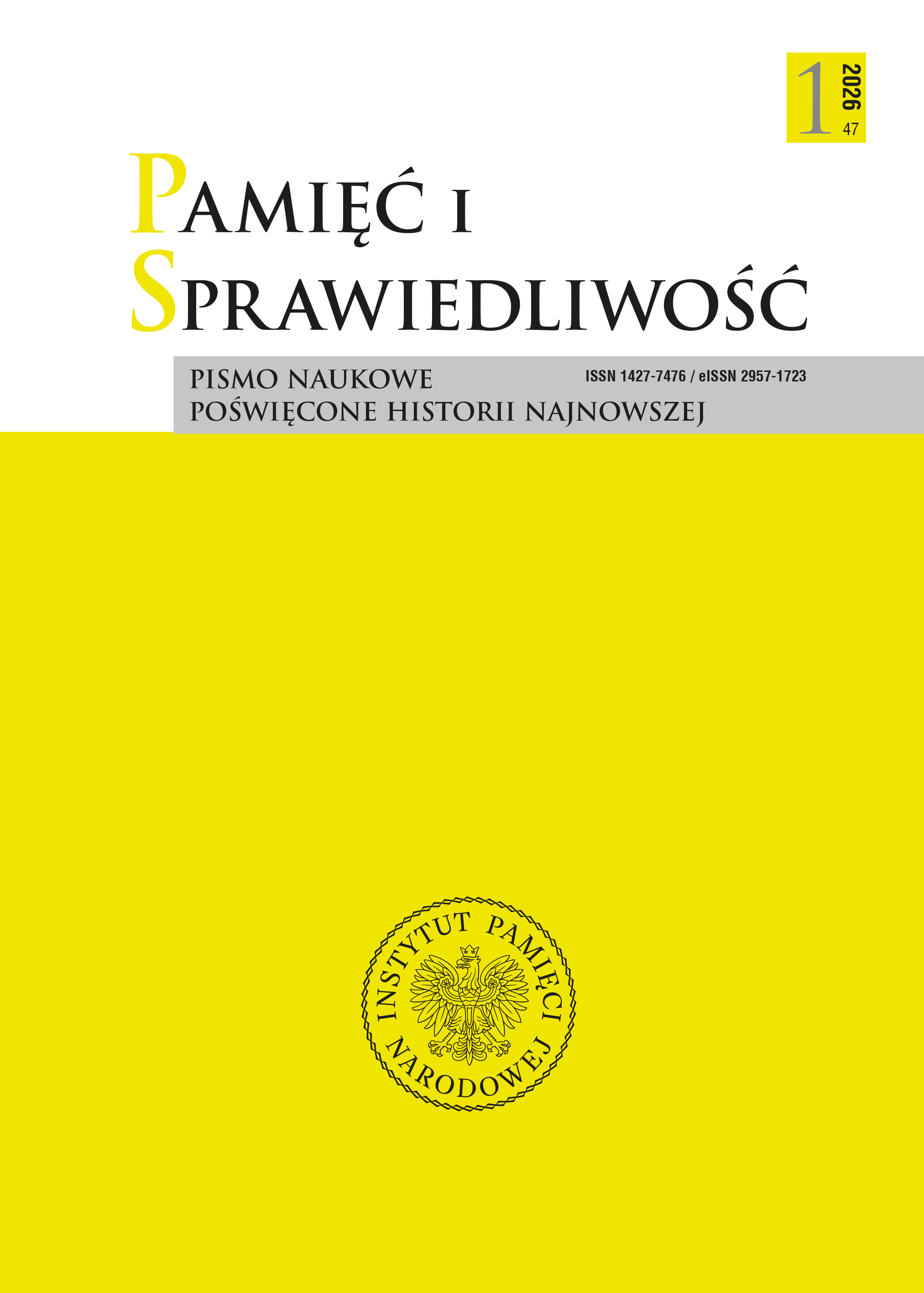
Pamięć i Sprawiedliwość
Tematem przewodnim „Pamięci i Sprawiedliwości” nr 47 jest manipulowanie obrazem historii w celach propagandowych przez różne ośrodki polityczne. W eseju omówiono to zjawisko w XX–XXI w., zaproponowano jego systematykę oraz podkreślono znaczenie narracji historycznych, skupionych głównie na latach 1939–1945, we współczesnych stosunkach międzynarodowych. W dziale „Studia” przedstawiono sowieckie manipulacje wydarzeniami politycznymi i historycznymi, mające na celu zdyskredytowanie II Rzeczypospolitej oraz przypisanie Niemcom dokonania zbrodni katyńskiej. Ukazano także sposób przedstawiania w III Rzeszy życia w okupowanej Polsce jako „normalnego” ciągu codziennych wydarzeń, śmierci gen. Władysława Sikorskiego i akcji „Burza” oraz elementy propagandowych realiów komunistycznej Polski: proces kpt. Barbary Sadowskiej i jej współpracowników oraz sposób przedstawiania go w prasie, znoszenie ograniczeń dotyczących możliwości mówienia o zbrodni katyńskiej, a także narrację gen. Wojciecha Jaruzelskiego na temat lat 80., mającą na celu uznanie go za współtwórcę demokratyzacji kraju. Dział „Varia” zawiera biografię kpt. Wacława Durysa – przedwojennego oficera, represjonowanego przez władze komunistycznej Polski pod fałszywymi zarzutami, pomoc (lub jej brak) okazywaną Żydom przez partyzantkę sowiecką na zachodnim Polesiu w latach 1941–1945, działania Biura Ochrony Rządu PRL w grudniu 1970 r. oraz dokumenty służb specjalnych USA dotyczące śmierci ks. Jerzego Popiełuszki. W dziale „Materiały i dokumenty” opublikowano broszurę z sierpnia 1945 r., zawierającą przystępny opis najważniejszych postaci i zjawisk politycznych z tego czasu, przedstawiony zgodnie z wymogami ówczesnej propagandy komunistów. Numer zamykają: recenzja z biografii prof. Zbigniewa Wójcika oraz sprawozdanie z konferencji naukowej poświęconej gen. Stefanowi Roweckiemu „Grotowi”.
 PDF (Język Polski)
Od Redakcji 
-
Od redakcji
Remembrance and Justice, Vol. 47 No. 1 (2026), pages: 9-10
Eseje
-
Falsehood and manipulation as tools for distorting historical consciousness (using selected examples)
Remembrance and Justice, Vol. 47 No. 1 (2026), pages: 11-54
The authors of the article discuss the issue of historical forgery and manipulation as an element of the disputes – or “games” – over memory waged by individual states (as well as by various circles and interest groups). They view the manipulation of history as an element of information warfare. At the same time, they point out that World War II remains a focal point in contemporary memory games. Drawing on examples primarily concerning World War II – as well as the actions of the USSR, the Russian Federation, Germany, Ukraine, and the authorities of the Polish People’s Republic – the concept of historical policy has been systematized by proposing a distinction between the policy of memory and the policy of historical manipulation. A typology of methods for manipulating history has also been formulated, alongside an analysis of the effectiveness of such manipulation across different political systems. Drawing on the example of propaganda from the martial law era and the contemporary state of historical awareness regarding this communist crime, a hypothesis was formulated concerning the persistence of distortions in historical memory into which false narratives are systematically introduced.
Studia
-
Three Examples of Soviet anti-Polish Disinformation in International Relations, Public Opinion, and Historiography (1920, 1934, 1939)
Remembrance and Justice, Vol. 47 No. 1 (2026), pages: 55-81
This article attempts to analyze Soviet anti-Polish disinformation – spanning international relations, public opinion, and historiography – through the lens of interwar relations between Warsaw and Moscow. The discussion focuses on three specific episodes in these relations. The first concerns the Polish-Soviet War as it entered its decisive phase; the Soviets succeeded in propagating the narrative that Poland bore responsibility for the conflict due to its rejection of Lenin’s peace proposals in the spring of 1920. The second example involves the 1934 Polish-German Non-aggression Declaration; Soviet diplomacy and propaganda alleged that the agreement was accompanied by a secret supplementary protocol envisaging an alliance between Poland and Germany against the USSR. Finally, the third example concerns the Soviet narrative claiming that the Polish government blocked the formation of a grand alliance against Germany in the summer of 1939 by rejecting Moscow’s demands for the Red Army to march across Polish territory to engage the Wehrmacht in combat.
-
Routinizing Power: Mechanisms of Communicative Ordering of Reality in the Press of the General Governorate (1940 – May 1941)
Remembrance and Justice, Vol. 47 No. 1 (2026), pages: 82-101
The article concerns the analysis of the mechanisms of communicative ordering of reality in the press of the General Governorate in the years 1940–1941. The aim of the study is to demonstrate that occupation propaganda functioned not only as an instrument of ideological persuasion, but above all as an element of administrative infrastructure, producing an impression of stability and normality. The analysis is based on three groups of sources: documents of the Department of Public Enlightenment and Propaganda, bulletins of the Pressendienst des Generalgouvernements, and the collaborationist Polish-language ‘reptile’ press (Goniec Krakowski, Kurier Radomski / Dziennik Radomski). The application of critical discourse analysis made it possible to capture the essence of the process of routinizing the occupation, understood as a shift from the language of violence to that of regulation, planning, and organization. The repetition of administrative categories, the technocratic style of communication, and the structure of the newspaper issue jointly created an interpretative framework in which the actions of the authorities were presented as orderly procedures rather than acts of domination.
-
British and German Disinformation Concerning the Death of General Władysław Sikorski: From Goebbels to Hochhuth
Remembrance and Justice, Vol. 47 No. 1 (2026), pages: 102-125
The death of General Władysław Sikorski in the Gibraltar air disaster on 4 July 1943 gave rise, even during World War II, to opinions suggesting that the Polish Prime Minister had been killed as a result of a plot. Some of them arose spontaneously, but it was Joseph Goebbels, the Third Reich’s Minister of Propaganda, who invented the narrative that Sikorski had been killed in an assassination organized by the NKVD in collaboration with the British. This propaganda was part of the Katyń propaganda campaign and was disseminated through newspapers, posters, leaflets, and radio broadcasts across occupied Europe. The aim of that disinformation was to break the Soviet-British alliance and intensify anti-Soviet sentiment within Polish society. During the Cold War, the conspiracy theory was taken up by the West German playwright Rolf Hochhuth, supported by the questionable scholarly authority of David Irving. In his play Soldiers, Hochhuth accused Winston Churchill of ordering his special services to kill Sikorski. The media discussion led to the launch of an internal investigation by British intelligence in 1969. It confirmed the conclusions of the 1943 inquiry that Sikorski’s death resulted from a plane crash, but detailed information was not disclosed to the public, and the authorities refused to appoint a new commission to investigate its causes. Regardless of the behind-the-scenes actions of the British authorities, Hochhuth’s play turned out to be an artistic and commercial failure. Its author also lost the lawsuits filed against him by individuals whom he had accused of complicity in the alleged assassination.
-
Operation “Tempest” and the Activities of the Polish Underground State in German Polish-Language Propaganda in the General Governorate
Remembrance and Justice, Vol. 47 No. 1 (2026), pages: 126-145
In early January 1944, the Red Army crossed the prewar eastern border of the Second Polish Republic, beginning the reoccupation of its eastern territories. Simultaneously, the authorities of the Polish Underground State launched a series of regional uprisings – Operation “Tempest.’’ These events were reflected in media outlets – press, posters, leaflets, etc. – issued by the Germans to Poles in the General Governorate. Events such as the Warsaw Uprising and the activities of the Home Army in the eastern territories of Poland were depicted in a way which served solely the German raison d’état. The author of the article presents examples, highlighting the specific content and style of this propaganda, as well as the intentions of the occupier, who, at the end of their presence in Poland, decided to openly acknowledge the existence of an organized Polish Resistance Movement.
-
The Katyn Case in the International Military Tribunal in Nuremberg. A Soviet Attempt at Judicial MANIPULATION and the Role of the Communist Warsaw Regime
Remembrance and Justice, Vol. 47 No. 1 (2026), pages: 146-195
The paper is a contribution to the history of the Katyn lie and the promotion of false history in the Soviet Union, communist Poland, and other Eastern Bloc countries. In the spring of 1940, Polish prisoners of war and other prisoners were mass-murdered by NKVD officers on several sites on USSR territory, including the Katyn forest. In April 1943, the Soviet authorities falsely accused the Germans of perpetrating the Katyn crime. The Soviets tried to legally support the Katyn lie using the International Military Tribunal in Nuremberg. During the main Nuremberg trial (1945–1946), the Katyn crime was included in the indictment of the Nazi defendants. During the hearings that took place in July 1946, the German defense lawyers successfully challenged the accusations. In its verdict, the Nuremberg Tribunal did not even mention the Soviet accusations concerning the Katyn crime. The Soviet manipulation failed also because of the integrated stance of the American and British members of the Tribunal. The paper discusses the context of the Soviet decision to pursue the judicial manipulation. The author sums up the knowledge about the Katyn case in Nuremberg, presenting also new information, e.g. on the background of the judicial proceedings. The role of the Warsaw communist regime in the Soviet judicial manipulation is also discussed, e.g. actions taken by Polish delegates to Nuremberg. The source material used includes the records of the Madden Committee of 1951–1952 and documents from the archives of the Institute of National Remembrance.
-
“The Last Trial of the Home Army”: The “Liceum” Intelligence Branch Before The Court, 9–18 July 1947
Remembrance and Justice, Vol. 47 No. 1 (2026), pages: 196-223
This article focuses on the show trial of the “Liceum” intelligence branch in July 1947. The prosecutor referred to it as the last trial in which the defendants invoked the Home Army (AK). The communist authorities aimed to discredit the AK, compromise its underground activities, and attack the Polish emigration authorities, particularly those gathered around General Władysław Anders. The main defendant, Capt. Barbara Sadowska, wanted to defend the AK’s reputation and secure the release of her associates. She managed to achieve the first goal, but at the cost of heavy sentences for her associates. The course of the trial was reconstructed on the basis of the court transcript. Its comparison with press reports in ten national and regional dailies revealed that the press portrayal of the trial differed significantly from the actual course of events. The “Liceum” trial was an intermediate step in the development of a proper model of the show trial in Poland. The experience gained by the authorities was utilized in the trial of the Second Main Directorate of the Freedom and Independence Association (WiN) and other show trials.
-
Coming to Terms with Katyn: The Evolution of Official Discourse in the Polish People’s Republic, 1987–1989
Remembrance and Justice, Vol. 47 No. 1 (2026), pages: 224-258
The article analyzes the place of the Katyn crime in the official public discourse of the Polish People’s Republic (PRL) between 1987 and 1989, as well as the transformations of that discourse during the final phase of communist rule. Drawing on extensive research into the press, television broadcasts, and statements by politicians and historians, the author reconstructs the evolution of the authorities’ official position on the Katyn massacre – from the propaganda narrative of German responsibility, through the graduał admission of the subject into public debate, to the partial questioning of the established interpretation. The analysis demonstrates that Katyn constituted an important element of the PRL’s politics of history and, at the same time, one of the key issues of the historical memory of Polish society in the late 1980s. Particular attention is devoted to the impact of perestroika and the political changes taking place in the Soviet Union under the leadership of Mikhail Gorbachev on the shape of official discourse in Poland. An important role was also played by the political decisions of Wojciech Jaruzelski’s leadership and by the activities of the Polish-Soviet commission of historians established in 1987. The author argues that changes in the way Katyn was discussed were gradual and carefully controlled, and that their pace depended largely on Polish-Soviet relations and the political situation at that time. As a result, the Katyn issue became one of the central themes of public discourse in the final years of the PRL, contributing to the delegitimization of the communist system and undermining the foundations of its propaganda.
-
“Without Martial Law, There Would Have Been No Round Table”: Wojciech Jaruzelski’s Vision of the Final Years of the Polish People’s Republic in His Historical Narrative as President (July 1989 – December 1990)
Remembrance and Justice, Vol. 47 No. 1 (2026), pages: 259-280
The article contains a short description of the most significant elements of Wojciech Jaruzelski’s historical narrative during his tenure as President of the People’s Republic of Poland / Republic of Poland (from July 1989 to December 1990). The analysis focuses on the vision of the years 1983–1989 created by the general, though it also includes references to his interpretation of martial law, which served as the primary point of reference in the presidential imaginarium. The author argues that given the failure of the political project associated with the reactivation of the presidency, Jaruzelski decided to use the office to attempt a rebranding of his image as the author of martial law; he sought to present himself as an advocate for change and, above all, to promote himself as the chief architect of democratization. The article is based primarily on fragments of speeches, interviews and other statements made by the general during meetings with Polish and foreign interlocutors.
Varia
-
Captain Wacław Durys (1893–1967): Professional Officer in the Army of the Second Polish Republic and Victim of Stalinist Repression
Remembrance and Justice, Vol. 47 No. 1 (2026), pages: 281-302
From 1918, Wacław Durys (1893–1967) took part in the Polish-Soviet War as a soldier in the Polish Army. During the interwar period, he served in the 4th Transport Division and then in the 10th Field Artillery Regiment (renamed the 10th Light Artillery Regiment in 1931). He took part in the Polish Campaign of 1939 and then became involved with the underground resistance in the occupied capital. He also took part in the Warsaw Uprising, during which he suffered a serious injury that ended his military career. After World War II, he first worked in local government (as mayor of the municipality of Grabów) and, after 1950, worked at the Kielce Regional Surveying Company in Łódź. Unexpectedly, in 1954, he was arrested by the Security Department and subjected to brutal interrogation. As a result, he confessed to being a member of an illegal organization called the Bataliony Chłopskie (Peasants’ Battalions) also known as Kadrowo Wojskowe Bataliony Chłopskie (the Military Cadre Peasants’ Battalions) and was sentenced to seven years in prison. He was a victim of Stalinist repression, as the charges and the sentence were unfounded. After his release from prison in 1955, he spent the rest of his life in Łódź, where he died and was buried.
-
The Attitude of Soviet Partisans toward Ghetto Escapees in Western Polesie as Reflected in the Testimonies of Local Jews
Remembrance and Justice, Vol. 47 No. 1 (2026), pages: 303-333
This article examines the relationship between Jews who had escaped from ghettos and labor camps in Western Polesie (present-day Belarus) and the Soviet partisans operating in the area between 1941 and 1944. Sources speak of at least 2,000 fugitives seeking refuge in the forests. Only about 300 of them survived until the end of the German occupation. The text explains why the vast majority of Jews perished. One of the causes was hostility from certain partisans. However, several hundred Jews survived the Holocaust primarily thanks to the help of partisans.
-
December ’70 Through the Lens of the Government Protection Bureau
Remembrance and Justice, Vol. 47 No. 1 (2026), pages: 334-358
This article examines the actions of a specialized unit of the Ministry of Internal Affairs, the Government Protection Bureau (BOR), during the serious social and political crisis that unfolded in December 1970. The actions taken in this increasingly tense and dramatic situation are described chronologically. These included specific actions by the BOR itself and it's director, Colonel Jan Górecki, as well as various interactions with the staff coordinating nationwide operations as part of Operation “Autumn ’70.” This operation was prepared in anticipation of a social revolt against the drastic price increase. Of particular interest is the depiction of the chaotic and desperate preparations to pacify the revolt, should it also reach the capital. This operation was codenamed “Bastion.” The author also seeks to provide a behind-the-scenes look at the mechanism of leadership transition at the highest levels of state power during the December ’70 crisis.
-
American intelligence responses to the murder of father Jerzy Popiełuszko. An analysis of declassified reports from 1984–1985
Remembrance and Justice, Vol. 47 No. 1 (2026), pages: 359-387
This article focuses on an analysis of declassified Central Intelligence Agency documents from 1984–1985 concerning the response of American intelligence to the murder of Father Jerzy Popiełuszko. The aim of the analysis was to determine what information American intelligence possessed immediately after the priest’s kidnapping and death and how it interpreted the significance of this event for the political stability of communist Poland (PRL) and its relations with the West. Eighteen CIA reports, as well as documents produced by the PRL security apparatus, served as the source material. Critical source analysis was employed, comparing American documents with Polish ones to reconstruct the informational context and possible channels for obtaining data. The analysis revealed that Popiełuszko’s murder was perceived by the American side as a test of the stability of the PRL system of government and a potential factor destabilizing state–Church relations. The CIA noted internal tensions within the Polish United Workers’ Party (PZPR) leadership and Warsaw’s dependence on Moscow. However, subsequent assessments concluded that General Jaruzelski managed to limit the scale of the crisis and exploit it in factional maneuvering. The hypothesis of possible KGB involvement was analyzed but was not clearly confirmed. The article argues that the Popiełuszko case was a tool for American analysts to assess the political condition of the PRL.
Materiały i dokumenty
-
The ABCs of Indoctrination: A Communist Dictionary for Soldiers from August 1945
Remembrance and Justice, Vol. 47 No. 1 (2026), pages: 388-440
The following publication presents an edition of the Political Glossary for Soldiers, originally published in August 1945. It contained a series of short texts concerning political life – devoted to various figures, events, and the like – written in the language of communist propaganda. The editor noted that the publication presented reflected the state of propaganda – which was rapidly changing at the time – that prevailed when the book was published. He also highlighted the numerous lies it contained, intended to impose upon the audience a worldview aligned with the expectations of the authorities in Warsaw and their Soviet masters.
Recenzje i polemiki
-
Mariusz Kolmasiak, Profesor Zbigniew Wójcik – patriota, strażnik pamięci Piłsudskiego, historyk, Wydawnictwo Instytutu Pamięci Narodowej, Warszawa 2025, ss. 840
Remembrance and Justice, Vol. 47 No. 1 (2026), pages: 441-449
Konferencje
-
Sprawozdanie z ogólnopolskiej konferencji naukowej „»Ja do niewoli nie pójdę. Wojna jeszcze nie skończona. Będę walczyć dalej« – w 130. rocznicę urodzin gen. dyw. Stefana „Grota” Roweckiego (1895–1944)”, Łódź, 25–26 listopada 2025 r
Remembrance and Justice, Vol. 47 No. 1 (2026), pages: 450-454
Most read (last 6 months)
-
Ukraińska socjaldemokracja w II Rzeczypospolitej (1928–1939)
 1522
-
Zbrodnia Wołyńska – stan badań. Postulaty i perspektywy badawcze
1002 -
The Japanese Plan to Dominate East Asia – The Greater East Asia Co-Prosperity Sphere
993 -
Bitwa o Arnhem i polska 1. Samodzielna Brygada Spadochronowa
753 -
Polska szkoła podstawowa w latach siedemdziesiątych i osiemdziesiątych w świetle wspomnień
723
Evaluation points allocated by Ministry of Education and Science
100 (2024; 140 - in 2023, 100 - in 2021)
Fields: history and archival science
Disciplines: history, literary studies, ethnology and cultural anthropology, Polish studies, protection of the heritage and conservation, family sciences, international relations
Editor-in-Chief: Sławomir Kalbarczyk PhD habil.

- INSTYTUT PAMIĘCI NARODOWEJ
Komisja Ścigania Zbrodni przeciwko Narodowi Polskiemu
ul. Janusza Kurtyki 1
02-676 Warszawa
NIP: 525-21-80-487
