 Język Polski
 English
 Français (France)
 Italiano
 Deutsch

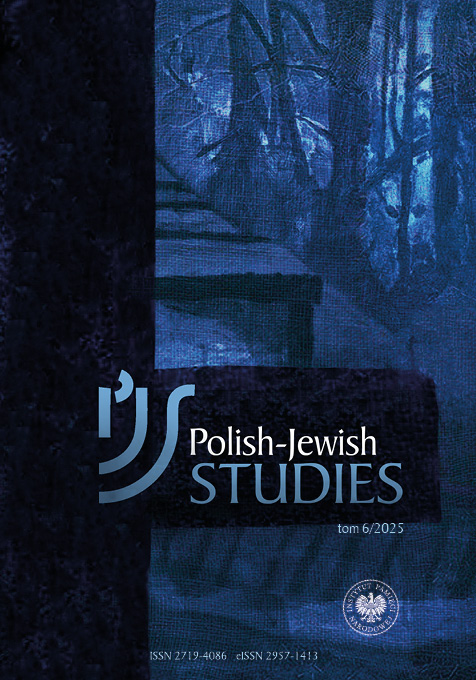
No. 6 (2025)
,,Polish-Jewish Studies” to dwujęzyczny (polsko-angielski) rocznik wydawany nakładem Instytutu Pamięci Narodowej, poświęcony dziejom społeczności żydowskiej na ziemiach polskich w XX w., kultywowaniu pamięci o polskich Żydach, a także złożonym relacjom polsko-żydowskim w tym okresie. W zamierzeniu Redakcji periodyk ma być forum wymiany aktualnych ustaleń badawczych w tej dziedzinie oraz miejscem dyskusji uczonych z różnorodnych ośrodków naukowych.
Tematem przewodnim numeru szóstego czasopisma są skomplikowane relacje polsko-żydowskie w okresie międzywojennym i w latach 1939–1945. Temu zagadnieniu poświęcony jest głównie dział ,,Studia”. Swoim zakresem obejmuje on również problem stanu badań nad stosunkami polsko-żydowskimi w historiografii polskiej. Ponadto są tam zawarte teksty odnoszące się do prześladowań ludności żydowskiej w okupowanej Polsce przez niemiecki aparat okupacyjny na poziomie lokalnym, a także do rozmaitych strategii jej przetrwania. Poruszono również problematykę negatywnych czynów popełnianych na ludności żydowskiej oraz ich rozliczenia. W numerze znajdziemy też odniesienia do powojennego stosunku podziemia niepodległościowego do tej grupy. Zachęcamy również do lektury artykułów zamieszczonych w działach „Źródła”, „Recenzje/Polemiki” oraz „Kronika”.
 PDF
PDF
-
Introduction
Polish-Jewish Studies, No. 6 (2025), pages: 9-12 (9-11)
Studies 
-
Polish-Jewish Relations During the Interwar Period in Polish Historiography. The State of Research
Polish-Jewish Studies, No. 6 (2025), pages: 15-58 (15-61)
The article discusses the state of research on Polish-Jewish relations during the interwar period, divided into projects, key publications, and specific issues. Due to the vast number of studies, the focus is only on the most important works and the most popular research topics. Polish-Jewish relations were examined from both micro and macro perspectives. The discussion yielded a number of research findings and proposals, highlighting previously overlooked yet critical areas for further investigation. Particular attention was given to definitional frameworks. The analysis incorporated publications from both the interwar and post-war periods. This work aims to introduce the reader to scholarly literature on Polish-Jewish relations, as presented in both Polish historiography and Jewish historiography authored in Polish, as well as to outline prevailing research trends.
-
Working for Germans as a Survival Strategy: Jewish Women in Occupied Cracow – Evidence from Testimonies and Memoirs
Polish-Jewish Studies, No. 6 (2025), pages: 59-96 (62-100)
The article examines the little-researched fate of Jewish women in German-occupied Cracow, focusing on their survival strategies on the so-called Aryan side. It analyses selected cases of women who hid under false identities and found employment with German officials and Volksdeutsche in Cracow and its surroundings. Particular attention is given to those women who, on Aryan papers – most often as Poles – left to perform forced labour in the Third Reich. This article examines strategies of survival in a German environment and how Jewish women adapted to extremely dangerous conditions. It also considers cases in which women were assisted, consciously or not, by Germans. The text draws on memoirs and is intended as a contributory study, outlining directions for further research, including the need to compare Jewish survivors’ testimonies with other accounts.
-
The Circumstances of Survival of the Jewish Population in Huta Pieniacka and Huta Werchobuska (Kreis Złoczów): Testimonies of Survivors
Polish-Jewish Studies, No. 6 (2025), pages: 97-129 (101-134)
The article explores the fate of Jews who went into hiding during World War II in the vicinity of Huta Pieniacka and Huta Werchobuska, located in the pre-war Tarnopol Voivodeship (Kreis Złoczów). The region’s extensive forest complexes offered favourable conditions for evading German extermination efforts. In these forests, groups of Jews who had escaped from liquidated ghettos and transports to death camps struggled to survive. The text draws on testimonies from Holocaust survivors, detailing their daily battles with hunger, disease, exhaustion, as well as constant fear. These accounts also shed light on the varied responses of the local population – both Poles and Ukrainians. On 28 February 1944, Huta Pieniacka was attacked by the 4th Police Regiment of the 14th Waffen SS Grenadier Division “Galizien,” with support from troops of the Ukrainian Insurgent Army (Ukrainska Povstanska Armiia, UPA). Some residents, having been warned of the impending assault, managed to flee; the others were murdered, and the village was destroyed. Although the pacification targeted the Polish population, it also had grave consequences for Jews in hiding, intensifying the danger and severing local support networks.
-
The Involvement of Police Forces in the Persecution and Extermination of Jews in Tarłów Between 1939 and 1944
Polish-Jewish Studies, No. 6 (2025), pages: 130-199 (135-205)
The article examines the role of police units established by the German occupying authorities in the surveillance, persecution, and extermination of the Jewish population in Tarłów, a village located in the Radom District of the General Governorate. The text presents biographical information on members of German, Polish, and Jewish police formations. Their actions targeted 1,500–1,700 Jews residing in Tarłów, approximately 500–700 Jews resettled there between October 1939 and September 1942 under the German policy of persecution, and an additional 5,000 Jews from neighbouring towns who were concentrated in Tarłów during September and October 1942. On 19 October 1942, around 7,000 Jews confined in the Tarłów ghetto were deported to the Treblinka II extermination camp, where they were subsequently murdered.
-
Działoszyce and the German Crime Against its Jewish Community During World War II
Polish-Jewish Studies, No. 6 (2025), pages: 200-279 (206-286)
Before World War II, the Jewish community made up the majority of Działoszyce’s population, then part of the Kielce Voivodeship, shaping it into a quintessential shtetl with a vibrant Jewish cultural and economic life. Following the German invasion of Poland in 1939, this entire world was shattered. As across all occupied Polish territories, the Germans imposed anti-Jewish laws and launched systematic persecution. What began with exclusion and segregation culminated in 1942, during Operation “Reinhardt” (Aktion Reinhardt), with the mass murder of all Jews in Działoszyce whom the occupiers had labelled as “unnecessary.” The article offers a detailed account of this process, using the example of a small provincial town to illustrate the fundamental mechanisms of the Holocaust. It also explores efforts at self-organisation, acts of resistance, attempts to rescue Jews on the so-called Aryan side, and the evolving dynamics of Polish–Jewish relations up to 1942.
-
The Extermination of Jews in the Kreis Rawa Ruska
Polish-Jewish Studies, No. 6 (2025), pages: 280-322 (287-330)
This text explores the systematic extermination of the Jewish population in a provincial region located in the eastern part of the former Lwów (now Lviv) Voivodeship, which, between 1941 and 1944, was elevated to the status of a German occupation-era administrative unit known as the Kreis Rawa Ruska (a county starosty). Drawing on archival records, eyewitness testimonies, and scholarly literature, it traces the unfolding stages of this process – from the initial outbreaks of violence following the German invasion in June 1941, through the establishment and operation of the ghetto, to the deportations to the Bełżec extermination camp and the eventual annihilation of the community. The narrative highlights both the direct role of the German terror apparatus and the responses of the local population in the context of aid provided to the Jews in hiding.
-
“I felt sorry for the people and didn’t obey the order…”. The Activity of Alfons Himmel, a Military Police Functionary from the Station in Lipsko, Kreis Starachowice (GG), as Reflected in Post-War Investigative and Trial Material
Polish-Jewish Studies, No. 6 (2025), pages: 323-349 (331-358)
Lipsko is a small town in central Poland. During the German occupation, it belonged to the Kreis Starachowice, which was part of the Radom District within the General Governorate (GG). Between 1940 and 1944, a military police station operated there, where one of the functionaries was Alfons Himmel. After the war, Himmel went into hiding but was eventually identified, apprehended, and sentenced to death in a 1949 trial. His testimony, along with that of numerous witnesses to his crimes, serves as a valuable source for understanding various aspects of the occupiers’ policies towards Poles and Jews – especially the reasons for and procedures surrounding arrests and executions. These accounts also shed light on the everyday interactions between the military police and the local population.
-
Criminal Proceedings Against Peter Leideritz, Gestapo Chief in Kołomyja, and His Wife Anneliese
Polish-Jewish Studies, No. 6 (2025), pages: 350-374 (359-383)
Following the war, Peter Leideritz, Gestapo Chief in Kołomyja, was tried before the Polish courts for his role in orchestrating the extermination of the Jewish population within his jurisdiction. His wife, Anneliese, faced charges related to crimes against Jews as well. Both were sentenced to death, although Anneliese’s sentence was later commuted to life imprisonment. This case study examines the post-war legal proceedings concerning crimes committed by the Germans in the county starosty of Kołomyja, located in the Galicia District of the General Governorate. It presents the couple’s profiles, details their activities, and traces the course of the trials across various courts, with particular emphasis on the defence strategies employed by the Leideritzes.
-
The Criminal Case of Michał Sokołowski: A Post-War Reckoning in Sanok for the Denunciation of Sheltered Jews and Their Shelterer
Polish-Jewish Studies, No. 6 (2025), pages: 375-399 (384-409)
This article investigates the criminal prosecution of Michał Sokołowski for denouncing Jews hiding in Sanok, along with the woman who helped them. It delves into the ethnic dynamics of the Sanok region before and during World War II, presents statistical data on the Jewish population’s wartime losses in the occupied Sanok County, outlines the legal framework for post-war justice, offers a detailed profile of the denouncer, and analyses the circumstances surrounding his actions. The article also features Wiktoria Kopiczak (Kosar), who sheltered Jews during the war, and outlines her prosecution before the German Special Court in Rzeszów, which initially sentenced her to death – a verdict later reduced to two years’ imprisonment through clemency. It further recounts the post-war trial of Michał Sokołowski before the Voivodeship Court in Rzeszów, culminating in a sentence of five years and one month in prison, along with a two-year revocation of his public and honorary civil rights.
-
The Killing of Jews in Działoszyce on the Night of 16–17 June 1945: Victims, Perpetrators, and Unresolved Questions
Polish-Jewish Studies, No. 6 (2025), pages: 400-433 (410-444)
This article seeks to explore the question of responsibility for the murder of several Jews in Działoszyce on the night of 16–17 June 1945. Given the current state of research, a definitive answer remains elusive. It is unclear whether the killings were part of a targeted liquidation operation conducted by an anti-communist and pro-independence underground combat group – possibly involving the units led by Corporal Jan Stempkowski “Michał,” Corporal Zbigniew Stawowczyk “Nurt” (Current), and Second Lieutenant Apolinary Kubicki “Grom” (Thunderbolt) – in response to a perceived, though potentially misidentified, threat. Alternatively, the murders may have been a spontaneous act driven by anti Semitic ideology, particularly the belief in “Jewish communism,” aimed at intimidating individuals suspected of collaboration with the newly established communist authorities. The first version is the most likely, which is also supported by the historical context and the sequence of events that took place in 1945 in Działoszyce and the surrounding area. However, given the serious concerns surrounding the reliability of the available sources – especially the investigative materials – any conclusions must be approached with considerable caution.
-
Between “Capture” and “Acting to the Detriment.” A Voice in the Discussion on Post-War Reckoning with Individuals who Participated in the So-Called Third Phase of the Holocaust. A Legal and Historical Perspective
Polish-Jewish Studies, No. 6 (2025), pages: 434-470 (445-482)
The article examines the context and rationale behind the Supreme Court’s decision of 18 October 1949, which broadened the definition of “capture” and influenced the legal treatment of individuals convicted in the late 1940s and early 1950s for various forms of involvement in the capturing of Jews between 1942 and 1945. This issue is primarily illustrated through the post-war criminal case of Adolf Kogut and Józef Szczepan, who were accused of informing the so-called Blue Police in Radgoszcz during the German occupation about the capture of four Jewish women in the village of Gruszów Wielki. They then transported three Blue Policemen by cart to the location, where the women were executed on the spot. The article explores the post-war legal proceedings and provides a microhistorical analysis of the deed committed by Kogut and Szczepan. This method aims to shed light on the distinctive nature of trials concerning this category of wartime crimes and the complex issue of the appropriate punishment for individuals who, under occupation, were compelled to participate in various activities related to the capture of people fleeing the Holocaust.
Reviews/Polemics
-
German Crimes Committed on Poles who Helped Jews – Reflections on Sebastian Piątkowski’s Monograph „W płomieniach zaś ciągle odzywały się jęki…”. Niemieckie zbrodnie na niosących pomoc Żydom Polakach z Ciepielowa i okolic (1942–1943) (“And Amidst The Flames, Moans Could Still Be Heard…”. German Crimes Against Poles who Helped Jews in Ciepielów and its Vicinity, 1942–1943), Warsaw: Institute of National Remembrance, 2025, 215 pp.
Polish-Jewish Studies, No. 6 (2025), pages: 473-483 (485-496)
-
A Gloss on the Review by Konrad Graczyk
Polish-Jewish Studies, No. 6 (2025), pages: 484-486 (497-499)
-
Dominik Flisiak, Antyżydowska zbrodnia w Przedborzu. Pytania, źródła, odpowiedzi (Investigating the Anti-Jewish Crime in Przedbórz: Questions Raised, Sources Examined, Answers Proposed), Chrzan, 2024, 234 pp.
Polish-Jewish Studies, No. 6 (2025), pages: 487-493 (500-507)
-
A Spatial Turn in Holocaust Studies. Anja Nowak, Violent Space. The Jewish Ghetto In Warsaw, Bloomington: Indiana University Press, 2023, 329 pp.
Polish-Jewish Studies, No. 6 (2025), pages: 494-502 (508-516)
-
Mario Wenzel, Arbeitszwang und Judenmord. Die Arbeitslager fűr Juden im Distrikt Krakau des Generalgouvernements 1939–1944 (Forced Labour And The Murder of the Jews: Labour Camps for Jews in the Cracow District of the General Governorate, 1939–1944), Berlin: Metropol-Verlag, 2017, 340 pp.
Polish-Jewish Studies, No. 6 (2025), pages: 503-508 (517-523)
-
Grzegorz Rossoliński-Liebe, Polnische Bürgermeister und der Holocaust. Besatzung, Verwaltung und Kollaboration, Berlin: De Gruyter 2024, 1124 pp.
Polish-Jewish Studies, No. 6 (2025), pages: 509-555 (524-570)
-
Dominik Flisiak, Antyżydowska zbrodnia w Przedborzu. Pytania, źródła, odpowiedzi (Investigating the Anti-Jewish Crime in Przedbórz: Questions Raised, Sources Examined, Answers Proposed), Chrzan, 2024, 234 pp.
Polish-Jewish Studies, No. 6 (2025), pages: 556-563 (571-578)
-
Rev. Tadeusz Krahel, Ratowanie Żydów przez duchowieństwo katolickie archidiecezji wileńskiej w czasie okupacji niemieckiej (1941–1944) (The Rescue of Jews by the Catholic Clergy of the Diocese of Vilnius During the German Occupation, 1941–1944), Białystok, 2024, 500 pp.
Polish-Jewish Studies, No. 6 (2025), pages: 564-570 (579-585)
Chronicles
-
Institute of National Remembrance, Branch in Rzeszów: Seventeenth Anniversary Events Devoted to the International Day of Commemoration in Memory of the Victims of the Holocaust in the Podkarpacie Region (20–30 January 2025). Report
Polish-Jewish Studies, No. 6 (2025), pages: 573-583 (589-600)
Most read (last 6 months)
 1192
1192 Evaluation points allocated by MInistry of Education and Science
20 (2024) (40 - 2023, 20 - in the list in force in 2021)
Fields: history, archival studies
Disciplines: history, security studies, political and administration studies, international studies
Editor-in-Chief: Dr. Tomasz Domański

- INSTYTUT PAMIĘCI NARODOWEJ
Komisja Ścigania Zbrodni przeciwko Narodowi Polskiemu
ul. Janusza Kurtyki 1
02-676 Warszawa
NIP: 525-21-80-487
- tel.: +48 22 581-87-78/77/76
e-mail: wydawnictwo@ipn.gov.pl
