 Język Polski
 English

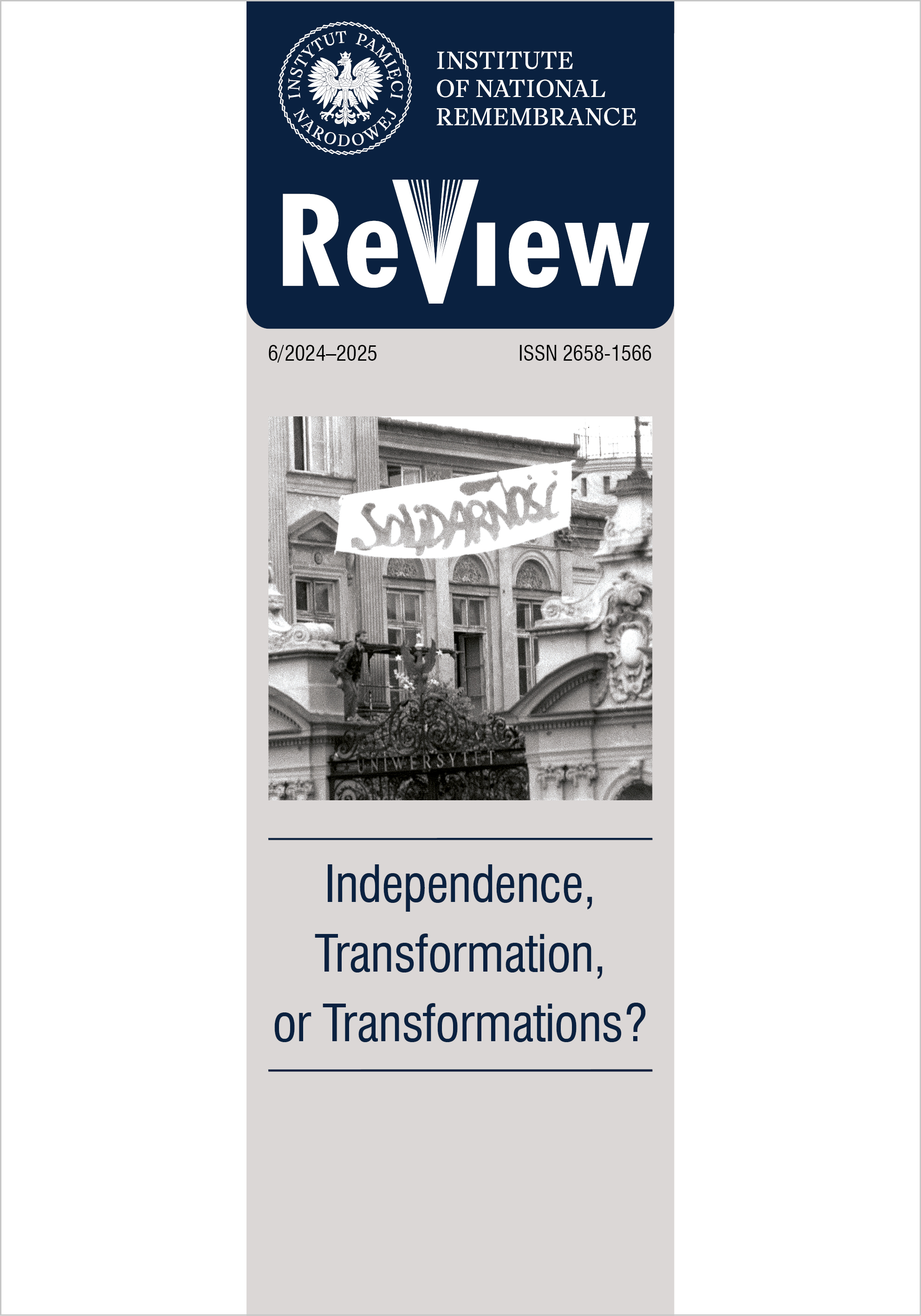
No. 6 (2024)
Independence, Transformation, or Transformations?
The issue concerns differing aspects of political and economic transformation in Poland and other countries of the former Soviet bloc in the Central and Eastern Europe. The transformation in Central and Eastern Europe is still commonly understood as a transition from communist dictatorship to political, personal, and economic freedom. The causes that initiated this transformation are well established: the Soviet Union’s defeat in its military-political rivalry with the United States, alongside the exhaustion of the Soviet Bloc’s economic model, which was ideologically driven and subordinated to the USSR’s economic and military imperatives.
The issue opens with a record of an editorial debate featuring Prof. Antoni Dudek, Prof. Krzysztof Brzechczyn, and Dr. Michał Przeperski – Polish scholars specialising in aspects of political and social transformation in Poland and Central Europe. Among the published texts is an essay by Prof. Alexandr Tomský on the effects of transformation in the Czech Republic, a presentation of the Berlin Wall Foundation, penned by Juliane Haubold-Stolle and Axel Klausmeier, and articles by: Andrzej Zawistowski (professor at the Warsaw School of Economics) on economic transformation in Poland at the turn of the 1980s and 1990s; Paweł Popieliński (researcher at the Institute of Political Studies of the Polish Academy of Sciences in Warsaw) on social transformation processes in East Germany; Marta Marcinkiewicz (researcher at the Institute of National Remembrance) on plans to introduce a state of emergency in Poland in 1988; Agnieszka Kolasa-Nowak (professor at Maria Curie-Skłodowska University in Lublin) on Polish sociologists’ perspectives on the interpretation of transformation in Poland; Antoni Dudek (professor at Cardinal Stefan Wyszyński University in Warsaw) on two significant cases of abuses related to the early transformation, namely the so-called alcohol affair and the process of so-called party nomenklatura privatisation; Cristian Vasile (historian at the Nicolae Iorga Institute of History in Bucharest) on the state of research concerning the Romanian revolution of 1989; and finally Andrei Ursu (historian at the Romanian December 1989 Revolution Institute) and Andreea Badila (historian at the Institute for Defence Political Studies and Military History in Bucharest) on the Romanian revolution of 1989.
INTRODUCTION 
-
Introductory Essay
Institute of National Remembrance Review, No. 6 (2024), pages: 1-17
 PDF
PDF
IN EDITOR'S DEBATE
-
“Transformation as a political myth is doing very well”. The transformation of the Soviet bloc: models, process, results (editorial debate). Warsaw, 27 September 2024
Institute of National Remembrance Review, No. 6 (2024), pages: 21-42
ESSAY
PRESENTATION OF REMEMBRANCE INSTITUTION
-
The Berlin Wall Foundation
Institute of National Remembrance Review, No. 6 (2024), pages: 58-85
The Berlin Wall Foundation is the central memorial to the history of the division of Germany after the Second World War into the Federal Republic of Germany (West Germany) and the German Democratic Republic (East Germany). Its key object is the Berlin Wall, which was built by the Communist Regime in 1961 as the 'Anti-Fascist Protection Rampart' (Anti-faschistischer Schutzwall), actually intended to prevent the own population of East German citizens from fleeing to the West. The border barriers in Berlin continued to be developed and perfected. Between 1961 and 1989, 140 people died at the Berlin Wall alone. The 2008-founded Berlin Wall Foundation therefore manages several sites relating to the division of Berlin, including the Berlin Wall Memorial, the East Side Gallery and the Marienfelde Refugee Centre Memorial. Its mission is to research, document and communicate the history of the division and to enable the victims of communist tyranny to be commemorated with dignity. The article not only conveys the history of the Berlin Wall and its peaceful fall, but also presents the core tasks of the foundation and its memorial sites.
ARTICLES
-
The Process and Consequences of East German Social Transformation after German Reunification
Institute of National Remembrance Review, No. 6 (2024), pages: 87-111
More than three decades after the reunification of Germany, significant differences between East and West Germany remain visible. The transformation process in the former German Democratic Republic (GDR) left lasting marks across various aspects of life for its citizens and the inhabitants of the new federal states within the Federal Republic of Germany. This article aims to analyse the course and assess the consequences of East Germany’s social transformation following reunification. It begins by outlining the theoretical framework underpinning the East German transformation, including key definitions, major theories, and prevailing research directions, alongside a brief overview of the reunification process itself. The central focus is on the trajectory and outcomes of the transformation, particularly in the social sphere. This includes examining issues such as unemployment, labour market challenges, wage disparities, demographic issues – including the emigration of young, skilled workers to the wealthier western states, and the resulting depopulation of numerous towns and villages. Additionally, the article explores the development of a distinct East German identity and the phenomenon of Ostalgie – nostalgia for life under the GDR – as well as electoral tendencies.
-
The State of Research on Political Transformation in Romania, 1989–1992
Institute of National Remembrance Review, No. 6 (2024), pages: 113-129
This article examines a few historiographical issues in Romania’s political transformation process which were significant for the transition from the communist dictatorship of Nicolae Ceaușescu to the political pluralism of the early 1990s. The article presents a selection of the main perspectives on the topic by representative authors while discussing several important concepts (national communism, national Stalinism, protochronism). Starting from here, the author remarks on the growing contestation, especially by some political scientists, of the concept of national communism as applied to the period of Ceaușescu’s rule. A further topic is the legacy of the communist regime, which was still visible after December 1989. Finally there comes an examination of the causes of the difficulties Romania faced in its transition from communism to a liberal democracy.
-
The Fall of the Last East European Dictator and Its Aftermath
Institute of National Remembrance Review, No. 6 (2024), pages: 131-163
The Romanian Revolution of 1989 was the only bloody one among that year’s upheavals in Eastern Europe. It was also the only one followed by an even bloodier, if short-lived, counter-revolution (on use and meaning of the term, see Meusel 1936; Tilly 1973; Allison 2022; Trăgători 2019; Căderea 2022). These peculiarities were largely due to Nicolae Ceaușescu’s tyrannic leadership style (see Otto 1990) (he also was known as the last ‘Stalinist’ of the Soviet Bloc, see Whitney 1989) and his Securitate. At the time, Romanian and foreign journalists as well as military and civilian actors of the events observed that after the dictator’s escape from the seat of power on 22 December 1989, a part of the Securitate continued to fight for his reinstatement (see Binder 1989; Romania 1989; and Romanian Revolution of December 1989 website). Combined with an intense psychological campaign meant to sow panic and chaos among the military and revolutionaries, their guerilla-style attacks were considered acts of terrorism. Yet after Ceaușescu’s execution, some of his loyalists were co-opted in the new administration’s intelligence units. The unresolved issue of the terrorists’ identity and the role of the Securitate plagued the Romanian transition to democracy and made the Romanian Revolution the most ‘entangled’ in Eastern Europe.
-
Tadeusz Mazowiecki’s Government’s Position on the So-Called Appropriation of State Property by the Nomenklatura and the So-Called Alcohol Affair
Institute of National Remembrance Review, No. 6 (2024), pages: 165-189
The article discusses Tadeusz Mazowiecki’s government’s reactions to two pathological phenomena that stirred up intense social emotions. The phenomena were a consequence of the actions taken by the last communist government of the Polish People’s Republic led by Mieczysław Rakowski. First of all, the analysis focuses on actions directed at people from the apparatus of the Polish People’s Republic, who acquired part of the assets of state enterprises and institutions using the legal regulations. The remainder of the article discusses attempts at counteracting the mass import of alcohol from abroad, which was causing considerable losses to the state budget.
-
Code Name “Horizon”. Preparations for the Introduction of a State of Emergency in the Polish People’s Republic, 1988–1989
Institute of National Remembrance Review, No. 6 (2024), pages: 191-251
This article discusses the actions undertaken by the authorities of the Polish People’s Republic to regulate the institution of a state of emergency within the communist dictatorship, as a result of the experiences of martial law (1981–1983), as well as the practical implications of these preparations in the context of the crisis in Poland in 1988 and the political process leading to the transformation of the political system in 1989. The worsening economic crisis in Poland in 1988 and, as a consequence, two waves of protests and strikes (in the spring and summer of 1988), prompted the authorities to move from formally creating the legal and organisational framework for a state of emergency to making preparations for its actual introduction, intended to pacify society. The threat of introducing a state of emergency was also used as a means of exerting pressure on the self-organising social resistance and on opposition representatives who had entered into dialogue with the authorities, seeking to increase civil liberties and human rights and to reform the political and economic system.
-
Polish Sociologists on the Transformation. Three Decades of Changing Interpretations
Institute of National Remembrance Review, No. 6 (2024), pages: 253-274
The aim of the paper is to show how the understanding of the transformation evolved over the last thirty years and how the way of thinking about this process has changed in Polish sociology. The subject of the analysis are sociological studies that concerned the transformation itself and its key dimensions. It was understood as modernisation in all its dimensions: economic, political, cultural, and social. Its main purpose was beyond dispute. Sociologists’ interpretations changed mainly under the influence of new circumstances, but their visions and beliefs also evolved. Over the course of three decades, three successive visions of the transformation were created, which indicated key structural factors, dominant actors, or conflicting interests: the idea of a quick transition, in which sociologists focused on recording changes and comparing them to a presumed goal; the concept of post-communism as a separate transitional period marked by a departure from rapid imitative modernisation; and a vision of transformation as an element of a wider, international context, crucial in which are the semi-peripheral location of Central and Eastern Europe and the regional history of modernisation of an underdeveloped area.
-
From a Centrally Planned Economy to…? The Early Years of Poland’s Economic Transformation
Institute of National Remembrance Review, No. 6 (2024), pages: 277-311
This article is devoted to the initial period of Poland’s economic transformation from a administrative-command system to a market economy. It covers the years 1988–1991, that is, three successive government cabinets. On the one hand, that transformation was accompanied by struggles arising from the legacy of the Polish People’s Republic – above all, inflation and shortages in the domestic market. On the other hand, during the same period, Poland initiated the efforts to integrate with the European Communities and to reorient its foreign trade priorities. The author argues that, in the economic sphere, the transformation preceded the political fall of communism.
 1232
1232 Evaluation points allocated by the Ministry of Education and Science:
40 (lists of 2023, and 2024; 40 - list of December 1, 2021; 20 - list of February 9, 2021).
Fields: history, archival studies
Disciplines: history, security studies, political and administration studies
Editor-in-chief: Franciszek Dąbrowski PhD


- INSTYTUT PAMIĘCI NARODOWEJ
Komisja Ścigania Zbrodni przeciwko Narodowi Polskiemu
ul. Janusza Kurtyki 1
02-676 Warszawa
NIP: 525-21-80-487
- tel.: +48 22 581-87-78/77/76
e-mail: wydawnictwo@ipn.gov.pl
